
Soil Troglodillo sp.
A sturdy, cave-born gem with earthy hues, lilac shimmer, and ghostly white legs — the Troglodillo you'll keep coming back to look at.
Overview
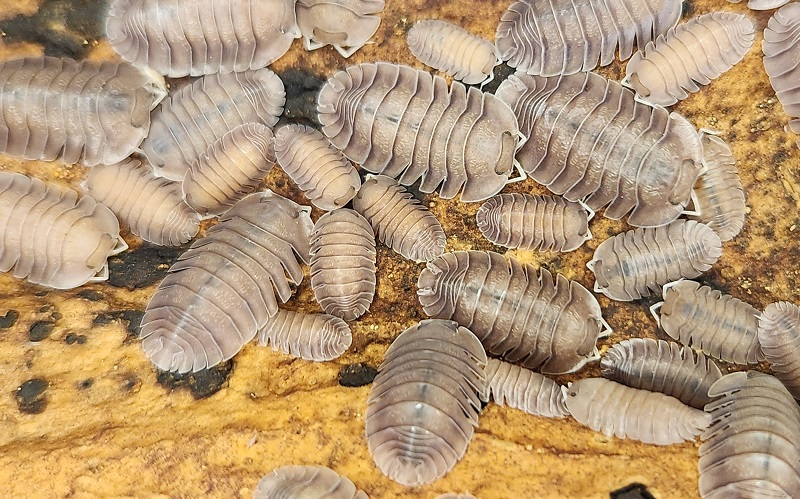
Troglodillo sp. 'Soil' — known in the hobby as T-Soil — is a cave-dwelling isopod from the limestone cave systems of Thailand and Vietnam. Its earthy dark gray and brown base shifts into subtle lilac and purple tones depending on light, and its strikingly bright white legs and antennae create a vivid contrast against the dark body. Compact and sturdy-looking, with a slightly flattened profile and Rubber Ducky-esque face, it occupies a unique visual niche in the Troglodillo genus. Formerly classified as Cubaris sp. 'Soil,' it has since been reclassified — though you may still see the Cubaris name used by older sellers.
Habitat & Setup
Substrate mix: For best results, use Isopod Paradise Organic Substrate specifically formulated to support healthy colonies. If you would rather mix your own, we recommend a blend of 70% organic topsoil, 10% flake soil, 10% milled sphagnum moss, 8% organics(mushroom compost, earthworm castings and leaf litter) and 2% calcium
Hides & decor: Cork bark (essential — they spend the majority of their time tucked underneath), rotting hardwood, generous hardwood leaf litter, botanicals. Deep hides that sit flush with the substrate are preferred. Add natural botanicals like seed pods and dried flowers to enrich the environment. Cuttlebone for calcium source.
Moisture: Maintain two-thirds of the enclosure consistently moist with a small drier area for self-regulation. Cave-dwelling origin means they prefer reliably humid conditions. Pair with springtails to keep the moist substrate healthy.
Diet & Feeding
Omnivorous detritivores with a good appetite. Leaf litter and rotting wood form the staple diet, supplemented with protein, vegetables, and calcium sources. In their native cave habitat they are also known to consume bat droppings and fungal matter — in captivity a varied diet with quality leaf litter and regular protein offerings replicates this well.
✓ Feed These
- Oak & hardwood leaf litter (staple)
- Rotting softwood and cork for grazing
- Dried shrimp, fish flakes
- Carrot, sweet potato, squash, zucchini
- Powder formulas like Isopod Chow, Repashy Morning Wood, Bug Burger, etc.
Feeding frequency: Rotate foods on a weekly basis. Remove leftover food when food begins to mold.
Breeding & Lifecycle
Moderate breeders. Colonies build steadily once conditions are stable, with reproduction occurring year-round in appropriate warmth and humidity. Females carry young in a marsupium (brood pouch) and give live birth to mancae that emerge as miniature adults.
Starting colony tips: Begin with 10–20 individuals in a 6 qt enclosure — keeping them together in a manageable space helps pairing. Once the colony is established and reproducing, upgrade enclosure size as needed.
Mancae care: Juveniles emerge as tiny but perfectly formed adults with the same characteristic white legs and antennae as adults. Offer fine crushed leaf litter and protein powder on the substrate surface for the first several weeks.
T-Soil was long classified as a Cubaris species — and is still sold under that name by many vendors — but taxonomy has since moved it to Troglodillo, a genus whose name literally means "little cave dweller." The name fits: in the wild these isopods inhabit the deep, dark, humid limestone cave systems of Southeast Asia, rarely seeing direct light.