
Red Panda King Cubaris sp.
The Panda King's striking sibling — rich red and white contrast in an equally regal package.
Overview
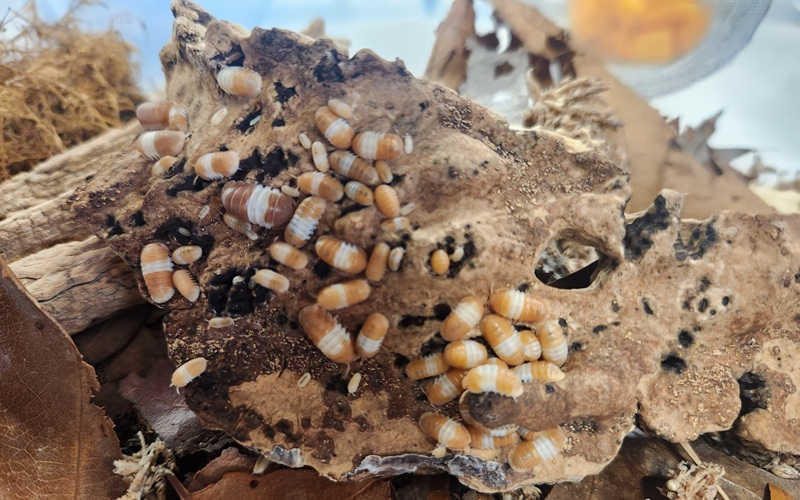
Cubaris sp. 'Red Panda King' shares the body shape and personality of the Panda King but replaces the black with rich red-orange tones, creating a stunning red-and-white display animal. Care requirements are nearly identical to Panda King — high humidity, stable warmth, and an undisturbed enclosure.
Habitat & Setup
Substrate mix: For best results, use Isopod Paradise Organic Substrate specifically formulated to support healthy colonies. If you would rather mix your own, we recommend a blend of 70% organic topsoil, 10% flake soil, 10% milled sphagnum moss, 8% organics(mushroom compost, earthworm castings and leaf litter) and 2% calcium
Hides & decor: Bark tubes and flats, leaf litter layer, moss patches, coco huts, lotus pods. Cuttlebone for calcium source.
Moisture: High gradient moisture — damp substrate 70/30 gradient. Mist weekly.
Diet & Feeding
Carotenoid-rich foods helps maintain the red coloration. Feed shrimp and carrot regularly.
✓ Feed These
- Leaf litter (staple)
- Sweet potato, carrot (carotenoid-rich — key for color)
- Dried shrimp, fish flakes
- Powder formulas like Isopod Chow, Repashy Morning Wood, Bug Burger, etc.
- Krill powder (occasional)
Feeding frequency: weekly. Remove leftover food when food begins to mold.
Breeding & Lifecycle
Breeds more reliably than many exotic Cubaris with consistent humidity and 78°F+ temperatures are key. Carotenoid feeding affects color of offspring.
Mancae care: Need high humidity and fine food particles. Carotenoid feeding from early life maintains color.
Colony tips: Red Panda King rewards consistency above all. A colony that's been stable for 6 months breeds far more reliably than a newly established one — resist the urge to intervene. Carotenoid feeding is a non-negotiable for color maintenance.
The 'Red Panda King' name merges two beloved animals — the red panda of Asia and the regal 'King' status of the Panda King isopod line.