
Red Ember Bees Ardentiella sp. "Red Ember Bees"
A fiery Southeast Asian Ardentiella with glowing amber-red and dark banding — the warmth of embers in isopod form.
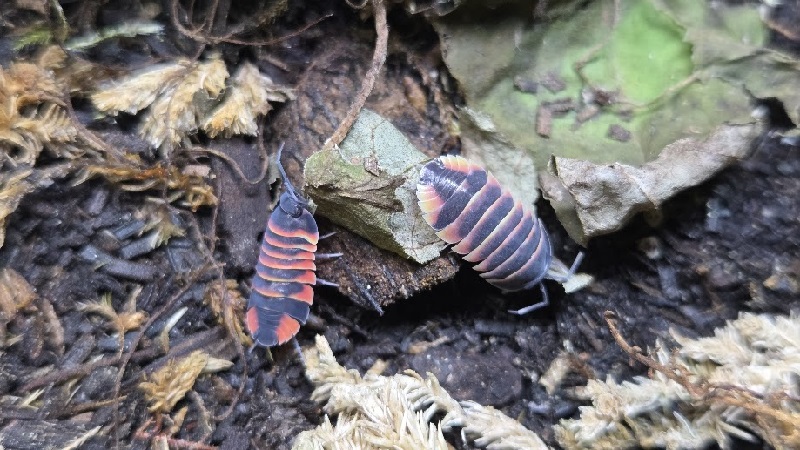
Overview
Ardentiella sp. "Red Ember Bees" is a striking tropical isopod from Southeast Asia displaying warm amber-red and dark banding reminiscent of glowing embers — and the bold striping pattern that gives "Bees" isopods their name. Like other exotic Southeast Asian isopods in this genus, it demands consistently high humidity and stable warmth, but rewards patient keepers with a visually stunning and highly distinctive colony.
The vivid red and amber coloration is partly diet-dependent — carotenoid-rich feeding keeps the ember tones intense across generations. This species is best suited to experienced keepers comfortable with advanced tropical isopod husbandry.
Habitat & Setup
Substrate mix: For best results, use Isopod Paradise Organic Substrate specifically formulated to support healthy colonies. If you would rather mix your own, we recommend a blend of 70% organic topsoil, 10% flake soil, 10% milled sphagnum moss, 8% organics(mushroom compost, earthworm castings and leaf litter) and 2% calcium
Hides & decor: Bark tubes and flats, leaf litter layer, moss patches, coco huts, lotus pods. Moss covered branches, lichen covered branches. Love to climb. Cuttlebone for calcium source.
Moisture: High gradient moisture — damp substrate 70/30 gradient. Mist weekly.
Diet & Feeding
Carotenoid-rich foods are essential for maintaining the vivid red and amber coloration that makes this species so distinctive. Feed dried shrimp and carrot consistently — a colony subsisting on leaf litter alone will gradually fade in color intensity over generations.
✓ Feed These
- Indian almond leaf litter (staple)
- Dried shrimp — key for color
- Sweet potato, carrot (carotenoid-rich)
- Powder formulas like Isopod Chow, Repashy Morning Wood, Bug Burger, etc.
- Krill powder, fish flakes (occasional)
Feeding frequency: Rotate foods on a weekly basis. Remove leftover food when food begins to mold.
Breeding & Lifecycle
A slow, methodical breeder that requires a fully established, stable enclosure before breeding begins in earnest. Consistent temperatures above 78°F adequate humidity are the two non-negotiables for reproductive success. Patience is essential —once established breeding can be quite prolific.
Mancae care: Mancae Red Ember Bees are small and have very little color. After the first few molts, color begins to show. Maintain high humidity without exception. Springtails are essential for managing mold around mancae. Ensure fine food particles (ground fish flakes, krill powder) are always present at the substrate surface.
Colony tips: Start with as many animals as you can. Carotenoid feeding from the earliest juvenile stages ensures offspring develop full color intensity. Consistency in care is more important than any single variable.
The "Bees" in this species' trade name refers to the bold striped banding pattern shared by a group of related Ardentiella morphs — not to any relationship with actual bees. The "Red Ember" coloration is carotenoid-based.