
Oreo Cream Porcellionides pruinosus 'Oreo Cream'
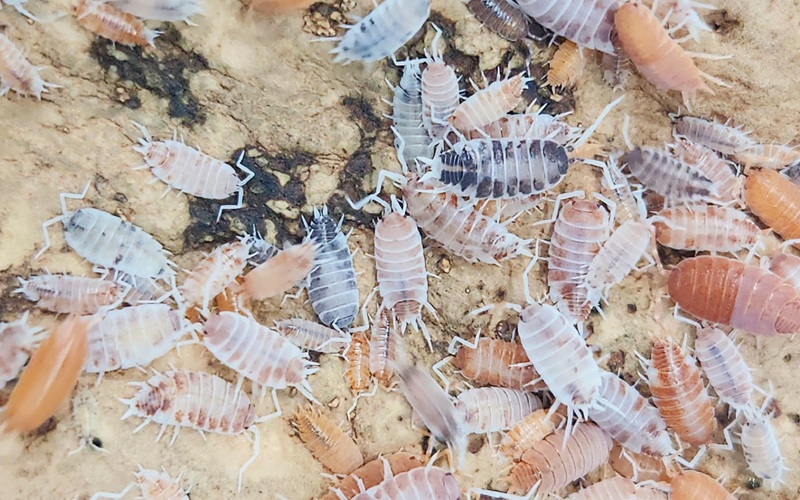
A creamy white pied morph with bold orange splotching — the dessert of the pruinosus world.
Overview
Porcellionides pruinosus 'Oreo Cream' is a selectively bred pied morph created by crossing Orange Cream and Oreo Crumble lines. The result is a white-to-cream base adorned with vivid orange splotches in patterns that vary between individuals. Fast, prolific, and beginner-friendly, it shares all the reliable traits of the pruinosus line while offering a striking color combination that stands out in any setup. Excellent for bioactive vivariums, display cultures, and as a soft-bodied feeder for smaller reptiles and amphibians.
Habitat & Setup
Substrate mix: For best results, use Isopod Paradise Organic Substrate specifically formulated to support healthy colonies. If you would rather mix your own, we recommend a blend of 70% organic topsoil, 10% flake soil, 10% milled sphagnum moss, 8% organics(mushroom compost, earthworm castings and leaf litter) and 2% calcium
Hides & decor: Bark, rotting hardwood pieces, generous hardwood leaf litter. They are fast and will use hides primarily to regulate moisture rather than for long-term shelter.Cuttlebone for calcium source.
Moisture: Maintain a moisture gradient with roughly half the enclosure damp and half dry. P. pruinosus is highly adaptable — it tolerates both semi-arid and humid setups — but consistent moisture access is needed for healthy molting. Add springtails to manage mold from heavy feeding activity.
Diet & Feeding
Enthusiastic, wide-ranging feeders. When protein is offered, they respond dramatically — clustering over food almost like a swarm. Protein once per week is adequate; more frequent offerings speed reproduction.
✓ Feed These
- Oak & hardwood leaf litter
- Dried shrimp or fish flakes
- Carrot, squash, zucchini, sweet potato
- Rotting hardwood for grazing
- Powder formulas like Isopod Chow, Repashy Morning Wood, Bug Burger, etc.
Feeding frequency:Rotate foods on a weekly basis. Remove leftover food when food begins to mold. Leaf litter and rotting wood can remain as a continuous background food source.
Breeding & Lifecycle
One of the fastest-reproducing isopods in the hobby. Colonies build rapidly under good conditions, and the pied coloring produces variable, interesting patterns in the offspring. Females carry young in a marsupium and give live birth; mancae are immediately active and fast.
Mancae care: Juveniles emerge tiny but fully formed and active. Offer fine food on the substrate surface. Their small size makes them ideal food for dart frogs and small reptiles — plan accordingly if mixing with vivarium inhabitants.
Colony tips: A group of 20 can become a thriving colony within 3–4 months. Oreo Cream coloring is variable — not all offspring will show strong orange patterning. This is natural variation, not a health issue.
Oreo Cream isopods are a designer mix of Oreo Crumble and Orange Cream isopods. They are both recessive genes of the Powder Blue and Powder Orange isopods. After multiple generations, the dominant gene Powder Orange or Powder Blue isopod can resurface before returning to their recessive Oreo Crumble or Orange Cream gene.