
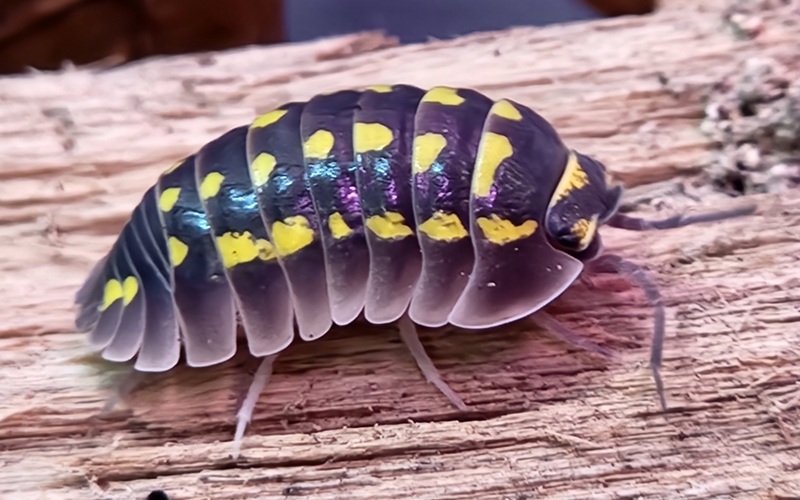
Yellow-Spotted Armadillidium gestroi
A sleek Italian isopod with subtle patterning and excellent vivarium utility.
Overview
Armadillidium gestroi is native to Italy and France, thriving in dry Mediterranean scrubland and rocky terrain. More drought-tolerant than many Armadillidium, it prefers drier conditions and good ventilation. An underrated species that performs excellently as a vivarium cleanup crew for Mediterranean or semi-arid bioactive setups.
Habitat & Setup
Substrate mix: For best results, use Isopod Paradise Organic Substrate specifically formulated to support healthy colonies. If you would rather mix your own, we recommend a blend of 70% organic topsoil, 10% flake soil, 10% milled sphagnum moss, 8% organics(mushroom compost, earthworm castings and leaf litter) and 2% calcium
Hides & decor: Bark tubes and flats, leaf litter layer, moss patches, coco huts, lotus pods. Cuttlebone for calcium source.
Moisture: Lean dry. Light misting of one small corner every 5–7 days is sufficient.
Diet & Feeding
Adapted to low-nutrient, dry environments. Feeds primarily on leaf litter and decaying organic material. Supplement calcium regularly.
✓ Feed These
- Oak & magnolia leaf litter
- Dried wood and bark
- Squash and carrot (small amounts)
- Fish flakes (1–2×/week)
- Bark tubes and flats, leaf litter layer, moss patches, coco huts, lotus pods. Cuttlebone for calcium source.
Feeding frequency: Rotate foods on a weekly basis. Remove leftover food when food begins to mold.
Breeding & Lifecycle
Slower breeder than vulgare or maculatum. Does best when conditions closely mimic its dry native habitat.
Mancae care: Mancae are hardy. Ensure fine food particles are available and that the substrate is not too loose or sandy for juveniles to navigate.
Colony tips: Start with a colony of 20+ adults and be patient — breeding accelerates once the colony is established. Dry conditions are critical; do not try to keep this species like a tropical isopod.
Armadillidium gestroi is adapted to survive drought conditions that would stress most isopod species — they can tolerate low humidity that would be fatal to Cubaris.