
Dwarf White Trichorhina tomentosa
The ultimate tropical cleanup crew — tiny, tireless, and practically invisible until you need them.
Overview
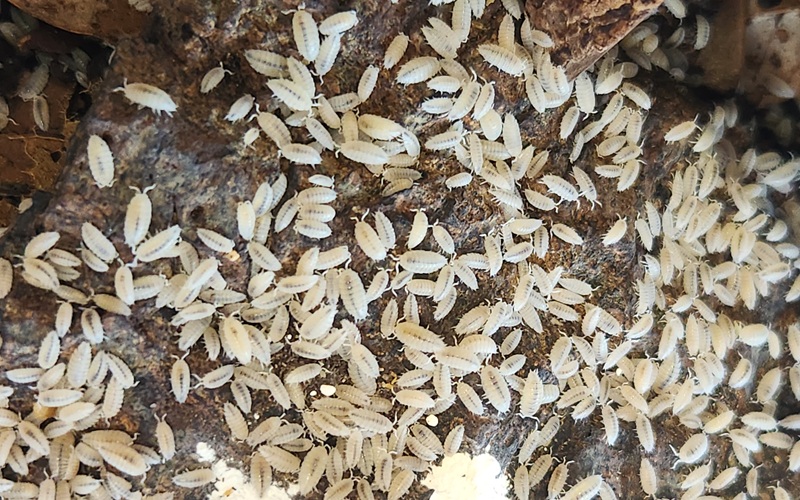
Trichorhina tomentosa — the Dwarf White Isopod — is one of the most widely used cleanup crew species in the bioactive hobby. Measuring just 3–5 mm as adults, they are nearly invisible to the casual observer, but their impact on substrate health is outsized. Native to the humid tropical forests and leaf litter zones of Central and South America, they thrive in warm, moist conditions, making them an ideal companion for dart frog vivariums, tropical gecko enclosures, and any high-humidity bioactive setup. They work alongside springtails to process waste, aerate substrate, and prevent mold build-up.
Habitat & Setup
Substrate mix: For best results, use Isopod Paradise Organic Substrate specifically formulated to support healthy colonies. If you would rather mix your own, we recommend a blend of 70% organic topsoil, 10% flake soil, 10% milled sphagnum moss, 8% organics(mushroom compost, earthworm castings and leaf litter) and 2% calcium
Hides & decor: Bark pieces, rotting hardwood, generous hardwood leaf litter. Their tiny size means they inhabit substrate interstices as much as surface hides.
Moisture: Keep two-thirds of the enclosure consistently moist. Maintain a small drier area for self-regulation. Pair with springtails in both culture and vivarium applications for maximum substrate health.
Diet & Feeding
Detritivores that process organic waste, decaying plant matter, animal droppings, and fungi. In bioactive setups they work continuously without the keeper needing to observe them feeding. Supplemental feeding is simple and infrequent.
✓ Feed These
- Oak & hardwood leaf litter (staple)
- Rotting softwood and cork for grazing
- Dried shrimp or fish flakes (1–2×/week)
- Powder formulas like Isopod Chow, Repashy Morning Wood, Bug Burger, etc.
- Cuttlebone — always available
Feeding frequency: Rotate foods on a weekly basis. Remove leftover food when food begins to mold. In an active bioactive vivarium, they largely subsist on waste and organic matter and require little additional feeding.
Breeding & Lifecycle
Remarkably prolific — and uniquely, Dwarf Whites are parthenogenetic, meaning females can reproduce without males. This means even a small starting group will build into a dense colony quickly. Mancae emerge as translucent miniature adults and are immediately integrated into the colony's cleanup activity.
Colony building: A starter group of 20–30 will establish quickly under warm, humid conditions. Because of their parthenogenetic reproduction, no males are needed — every individual in the colony can contribute to population growth.
Vivarium use: In a planted vivarium, Dwarf Whites self-regulate their population based on available food. They will not overrun a well-maintained setup — they only boom when there is excess organic matter to consume.
Trichorhina tomentosa reproduces parthenogenetically — females can produce offspring without mating. This makes them one of the only isopod species where a single individual can, in theory, found an entire colony. It's also one of the reasons they build population so rapidly once conditions are right.