
Citrus Cubaris sp.
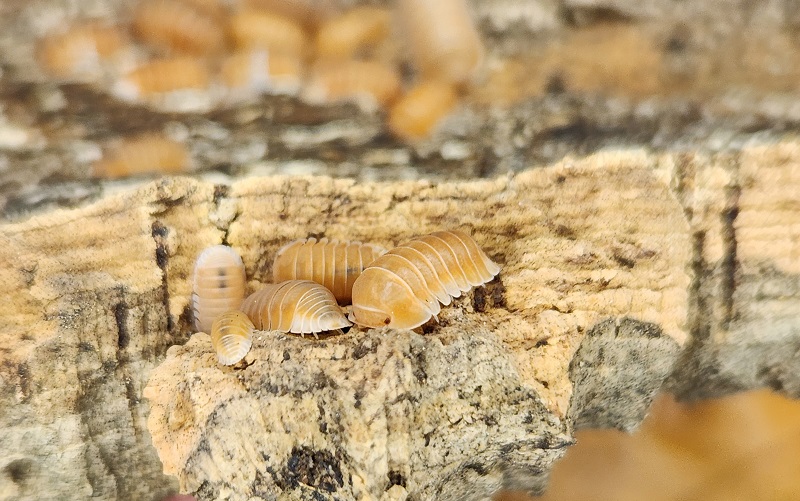
A vibrant tropical Cubaris with bright yellow-orange citrus coloration.
Overview
Cubaris sp. 'Citrus' displays striking yellow to orange coloration on a contrasting dark background. Like other Cubaris sp. from Southeast Asia, it requires consistently high humidity, stable warmth, and a moist tropical substrate. The vivid color makes it a standout display animal. The Citrus morph is an albino mutation in a panda king colony.
Habitat & Setup
Substrate mix: For best results, use Isopod Paradise Organic Substrate specifically formulated to support healthy colonies. If you would rather mix your own, we recommend a blend of 70% organic topsoil, 10% flake soil, 10% milled sphagnum moss, 8% organics(mushroom compost, earthworm castings and leaf litter) and 2% calcium
Hides & decor: Bark tubes and flats, leaf litter layer, moss patches, coco huts, lotus pods. Cuttlebone for calcium source.
Moisture: High gradient moisture — damp substrate 70/30 gradient. Mist weekly .
Diet & Feeding
Carotenoid-rich foods (carrot, sweet potato, dried shrimp) help maintain the vivid yellow-orange coloration.
✓ Feed These
- Oak & magnolia leaf litter
- Sweet potato, carrot (carotenoid-rich)
- Dried shrimp, fish flakes
- Powder formulas like Isopod Chow, Repashy Morning Wood, Bug Burger, etc.
- Mushroom pieces
Feeding frequency: Rotate foods on a weekly basis. Remove leftover food when food begins to mold.
Breeding & Lifecycle
Breeds steadily with consistent warmth and humidity. Feed carotenoid-rich foods to support color expression in offspring. Females can produce new broods every 1-2 months.
Mancae care: Need consistent humidity and fine food particles at substrate level.
Colony tips: Carotenoid-rich feeding across all life stages helps maintain color intensity in the colony.
Despite being named 'Citrus,' actual citrus fruit is harmful to isopods due to acidity and essential oils — feed sweet potato and carrot for the orange hues instead.