
Cherry Blossom IsopodCubaris sp. "Cherry Blossom"
A rare, pastel-pink Cubaris cultivar prized as a premium display species.
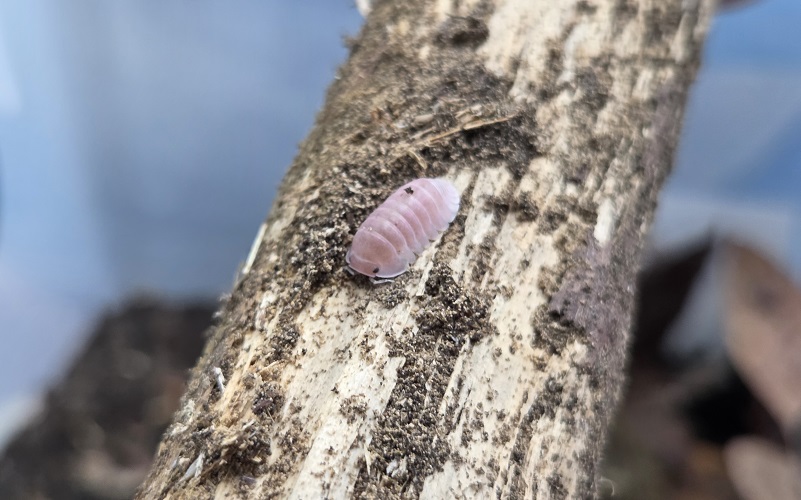
Overview
Cubaris sp. "Cherry Blossom" is a selectively bred color line isolated in Japan from Cubaris sp. "Red Pak Chong" stock. It's prized for its soft pastel-pink body broken up with pale cream segmentation. As a true Cubaris, it's a tropical, cave-dwelling species that wants stable warmth and high humidity rather than a dry gradient, and it breeds more slowly than hardier clean-up crew isopods.
Habitat & Setup
Substrate mix: For best results, use Isopod Paradise Organic Substrate specifically formulated to support healthy colonies. If you would rather mix your own, we recommend a blend of 70% organic topsoil, 10% flake soil, 10% milled sphagnum moss, 8% organics(mushroom compost, earthworm castings and leaf litter) and 2% calcium
Hides & decor: Cork bark, decaying hardwood, moss cover, leaf litter piles
Moisture: Keep substrate evenly moist throughout with gentle cross-ventilation. Cherry Blossoms want less airflow than a Porcellio or Armadillidium, but stale, stagnant air invites mold just as fast as too little moisture.
Diet & Feeding
Cherry Blossoms eat a varied tropical diet centered on decaying wood and leaf litter, with occasional protein and produce.
✓ Feed These
- Decaying leaves and white-rotted wood
- Forest moss and lichen
- Fish flakes or gammarus shrimp (1–2×/week)
- Cuttlebone or limewood — always available
- Soft fruits and veggies in small amounts
Feeding frequency: 2 times per week. Remove uneaten soft food within 48 hours, and pair the colony with a springtail cleanup crew to help manage mold risk in this high-humidity setup.
Breeding & Lifecycle
This is a slow-breeding species. An established colony builds gradually over several months — start with a small group and avoid disturbing them while they settle in.
Mancae care: Juveniles are pale and largely colorless at first, developing their signature pink gradually. Offer fine powdered foods on the substrate surface for the first few weeks.
Colony tips: Resist the urge to dig through the substrate to check on them — frequent disturbance is one of the most common reasons a colony stalls out.
Cherry Blossom isn't a wild species — it's a color line isolated in Japan from Cubaris sp. "Red Pak Chong,".